Introduction
This website exists to provide information about the proposal for a Cam and Berkeley Team Ministry. Primarily in the form of Frequently Asked Questions. More information may be added at a later date, and so it is worth making a return visit in the future.
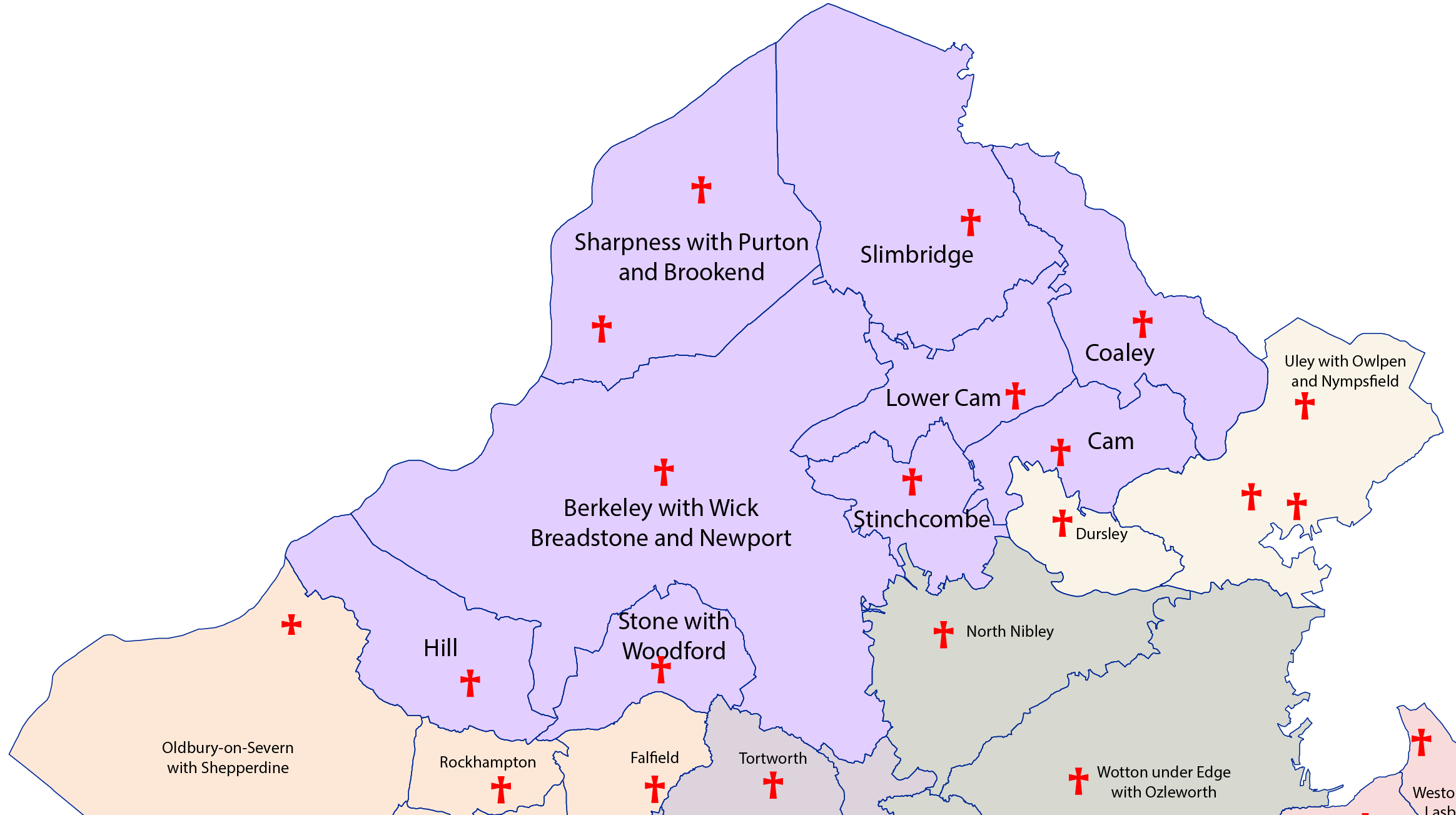
Nine parishes, ten church buildings, three full-time vicars
and
three volunteer vicars, five volunteer readers, numerous churchwardens, treasurers, PCC members, lay worship leaders, lay mission and ministry leaders and many more.
The nine parishes are the parish of Cam, the parish of Stinchcombe, the parish of Lower Cam, the parish of Coaley, the parish of Sharpness with Purton and Brookend, the parish of Slimbridge, the parish of Berkeley with Wick, Breadstone and Newport, the parish of Stone with Woodford and the parish of Hill.
Frequently Asked Questions
Below are the questions that various members of the PCCs have asked as we have prayed and discussed this proposal. You may find them helpful, too, as you consider what it might mean to begin working together more formally as a team of parishes.
At the end of the FAQs, there is a chance for you to comment or ask your own question via a form. You can also simply be in touch with your vicar, Graham, Steve or Fiona.
New questions asked in person or via the form below
Does this mean I will need to go to other churches?
No. There are no plans to change the current service pattern, and we remain committed to local mission and ministry in our parishes.
Does this mean that all our finances will have to be pooled together?
No. Each parish will remain a PCC, controlling its own finances.
Is the real reason of having an Area Team to make it easier for when it is no longer financially viable to have three paid Vicars and reduce it to two?
The real reason for this proposal is so that the mission and ministry leadership team can better serve mission and ministry in our parishes.
Our Diocese, and our Bishops and Archdeacons, are committed to providing local stipendiary vicars. As a Diocese, we have finances to support our current committments for the foreseeable future.
There is no part of our deanery strategic planning that involves closing churches or reducing vicar numbers.
The Team Rector designate is committed to keeping churches open and sustainable with healthy Christian communities at their heart.
The plan suggests that the Team Area will be nominally split east/west of the M5/A38. This suggests to me that Slimbridge is essentially moving to the Vicar in charge of Berkeley. Isn't this just to releive the Vicar of Lower Cam/ Coaley of his responsibility?
We have identified two mission areas: Berkeley and the surrounding villages, and Cam and the surrounding villages.
This is based nominally on where people focus their attention and where natural connections are currently in place. However, it is very difficult to draw any hard lines, as so many social connections will cross them.
Regardless of this, the clergy team will serve and take responsibility for all the churches within the team. There is no division of responsibility. However, it is clear that some clergy will take specific responsibility for some PCCs and parishes.
There is no current plan to ‘move’ Slimbridge to ‘Berkeley’.
Addition of a Rector overseeing the other paid Vicars introduces yet another layer of "Management" within the Diocese. We already have Bishops, Archdeacons, Area Deans. Can one of these other layers now be removed and have more Vicars "on the ground"?
The position of Team Rector is not a management layer. We will have three vicars ‘on the ground’. One will have the specific responsibility of leading the team of vicars and other mission and ministry leaders.
The positions of Bishops, Archdeacons and Area Deans are also not management layers. These are offices with specific responsibilities to serve and lead our clergy and church communities in mission and ministry within the diocese.
Why?
Why are we doing this?
The current model of ministry is stretched beyond reasonable expectations. Team Ministry offers collaboration, sustainability, diversity of gifts, reduced risk of vacancy, and a healthier pattern of mission and ministry that reflects the body of Christ.
What is the current model of mission and ministry?
In short, one parish, one vicar and often one curate. It has been a long time since this was strictly the case in the Wotton Deanery. Over time, one vicar has been asked to take responsibility for two, three, four, five and more parishes. Alongside this, the demands of the role of the incumbent have grown; by population, by legal and ecclesiastical processes and expectations. This model of one vicar and multiple parishes is stretched to breaking point.
If Team Ministry is so good, why have we not done this already?
Team ministry has been an option for some time. There are currently six team ministries in the Gloucester Diocese, with more under exploration. This is also true in other dioceses, although they can be known by other names.
In short, there needs to be an appetite amongst the clergy and lay leaders of local parishes to work together and explore the possibilities. Perhaps driven both by a recognition that the current model might not be fit for purpose any longer and that God might be doing something amongst us.
Are there any alternatives?
Yes. It is possible to form informal working arrangements. You might say that is already the case, as clergy in these parishes have been increasingly working together for nearly two years.
It is also possible to form a group ministry, which puts a legal framework around such informal working arrangements. Within a group ministry, the individual benefices remain in place; in our case, there are four benefices.
In contrast, we are choosing a Team Ministry because of the extra stability and resilience that comes with the robust legal framework it provides.
Who will be our vicar?
Who will be our vicar?
Legally, everyone will have three vicars: Fiona, Graham and Steve. Practically and pastorally, people will relate to one or more of these vicars as relationships and situations emerge, grow and change.
The beauty of a team is variety. Different people relate to and respond in different ways. Simply put, if you don’t easily relate to Graham, you might find it easier with Steve or Fiona.
Will individual members of the clergy team be appointed to lead specific churches?
Legally, the three clergy will share the ‘cure of souls’ together with the Bishop in all nine parishes. They will each carry incumbent status. Currently, our vicars live in particular parishes, and that will remain, but they will share overall responsibility for all nine parishes. One of the three will be appointed as the Team Rector, whose role is primarily to lead the team. How a team functions day to day and week to week largely rests with the team itself, clergy and PCCs, guided by agreed-upon values and principles.
Local parishes remain at the heart of the Team. Part of the rationale for this move is to ensure that individual parishes feel supported and secure.
Who will hold responsibility for the running of each parish, together with its PCC?
Allocating priests and leaders to services and roles will be decisions within the hands of the clergy team and PCCs. These decisions, like all mission and ministry, will be regularly reviewed.
In the first place, it may be wise to retain existing allocations. It is also anticipated that if a PCC faces a particular issue and a given incumbent has relevant experience, it may be appropriate for them to chair that PCC for a period of time. These decisions remain within the hands of the incumbents and PCCs. All three incumbents become ex officio on each PCC, although there will be no expectation for each incumbent to attend each PCC.
Who will be the person that the congregation or wider public interact with when arranging life events, both administratively and pastorally?
Regarding pastoral care, experience of forming Teams suggests a natural freedom and association develops. People approach the vicar with whom they feel comfortable and confident, regardless of who their ‘allocated’ vicar might be. This already happens in many benefices where there is more than one ordained minister.
Regarding Life Event services, these are already assigned based on the availability of dates and vicars. Families often see the vicar who conducts a Christening or funeral as “their vicar,” regardless of the legal position. This practice will continue.
Mission and ministry
How will mission and ministry be organised geographically?
There will be two mission and ministry areas:
- Berkeley and the surrounding villages
- Cam and the surrounding villages
This broadly coincides with the A38. We do not expect people from Stone to attend church in Coaley, except on rare occasions such as a Team Gathering.
Which clergy will focus on which areas?
It is anticipated that Steve Godsell will focus on the Berkeley area, while Fiona and Graham will focus on the Cam area. Graham will also hold the responsibility of Team Rector and continue as Area Dean.
Clergy will occasionally minister outside their main area so that congregations and clergy do not become strangers.
Will a team ministry mean more capacity for mission and ministry?
Yes. In the short and medium term, we will be able to consolidate various administrative and operational systems. This will mean that individual vicars spend less time behind a computer screen and more time focused on engaging with church and parish communities. For example, at the moment, each vicar, whether themselves or through an administrator or volunteer, maintains a system for booking, arranging and taking a funeral. Whilst legally working together, we will be able to develop one system that serves all three incumbents and all nine parishes.
What about Readers, Self-Supporting Priests, PTO clergy, and Lay Ministers?
Readers, Self-Supporting Priests, priests with Permission to Officiate, and Lay Ministers may focus on particular parishes, projects across parishes, or specific mission activities. As volunteers, this will largely be their choice, to either focus on one parish or a number of parishes, or be deployable wherever there is need.
How many services can the Team support each week?
This will be discerned collaboratively, reviewed regularly, and shaped by mission priorities rather than fixed formulas. There is nothing in the current proposal to move to a Team Ministry that will affect the number or types of services.
Diversity within mission and ministry
Will all parishes accept the ministry of women priests and bishops?
Yes. All current parishes accept the ministry of priests regardless of gender.
Will there be priests willing to conduct services of blessing for same-sex couples if authorised?
Among the current clergy team, there are priests willing to conduct such services once authorised. Details will depend on Synod decisions and any emerging regulations.
This will be considered in future clergy appointments to the Team, to the extent legally permitted.
Appointment of clergy
How will a Team Rector be appointed?
The Team Rector is appointed through the Patronage Board [see below]. If the role becomes vacant, the normal appointment process applies. A current Team Vicar may apply for the role.
Will the role of Team Rector rotate?
Rotation is possible in theory, but the appointment process follows established procedures rather than automatic rotation.
Who will be the first Team Rector?
Initially, the Team Rector will be appointed from the existing clergy team. Following discussions amongst themselves and with the Bishops, Rev Graham Stacey will be appointed as the first Team Rector.
What happens when a parish goes into vacancy?
No parish will enter vacancy in the way a single-incumbent benefice does. If a vicar leaves, leadership continues with the remaining clergy while recruitment takes place. In other words, there is a vacancy in the team rather than a vacancy in a particular benefice or parish.
In a team vacancy, will each parish still prepare a profile reflecting its needs and style?
A benefice profile and person profile will be prepared. The interview panel will seek to understand the needs of the parishes and the team and discern what God may be saying through the process.
Will each parish appoint its own representatives to the appointment process?
With the formation of a single benefice [a team ministry], a Patronage Board will be formed. This board will include the Bishop, Archdeacon, Patrons, the Team Rector, alongside an agreed number of lay representatives.
A representative from every parish would make the panel unmanageably large. Lay, or as they are known technically, ‘parish representatives’ should appropriately reflect the mission and ministry focus of the role being recruited for (e.g. Berkeley or Cam).
Patrons
Will the role of the patrons change?
When parishes join a multi-parish benefice, as this Team Ministry will be, patronage is assumed for the whole benefice. Patrons are expected to consider the needs of the whole benefice wisely. Relationships with our current and active patrons are strong.
Finance and Parish Share
How will Parish Share be allocated across the new benefice?
There will be no change in the current guiding principles. Individual PCCs will come to their own decision and work collaboratively to agree on what can be given towards the benefice parish share request based on three stipendary clergy.
The diocese is committed to providing stipendary clergy regardless of short-term ability to meet costs.
Will each parish have to share their financial resources?
No. Each parish will remain as its own legal body subject to canonical, legal and charity legislation. The finance of a single parish is legally protected and controlled by the trustees, the PCC.
However, it is hoped, as brothers and sisters in Christ, that we will share mutual burdens, act generously and kindly to needs and hold all our resources with an open hand before God. This takes time, relationship and trust.
How will clergy time be divided between parishes of different sizes?
These decisions require agreed values rather than purely financial calculations. Proposed values include:
- Effective mission and ministry for each parish
- Sustainable clergy ministry
- Clergy-led but not clergy-dependent ministry
Do parishes get “what they pay for” in terms of clergy time?
Mission need, discernment, and sustainability will guide decisions, not payment alone. Parishes may receive additional focus for a season, regardless of financial contribution.
Governance
Will PCC governance be affected by this proposal?
No. PCCs remain the legal body, and, aside from complying with canonical, legal, and charity legislation, no one can compel a PCC to make any decision or take any action.
However, PCCs may decide that, for the sake of expediency and common sense, to delegate some power and decisions to a Team Council. A Team Council could be formed within the current Church Representation Guidelines.
What is a Team Council?
A team council is a body of people formed from the PCCs to enable some shared governance. Each PCC will need to agree on the formation, make-up and delegated powers of a Team Council before it can be formed. A Team Council can only operate with the delegated powers given by all the PCCs.
Testing this direction of travel
Is this change reversible?
While technically reversible, it would be unwise in the short to medium term. The move is intended as a long-term strategy
Can there be a trial period?
In effect, a trial period is already underway. The clergy team has been working closely together for nearly two years.
What happens next?
- Clergy and PCCs discuss and agree on the direction of travel.
- The Bishop and the Archdeacon ensure correct process has been followed and satisfy themselves that there is a strong appetite for this amongst the PCCs.
- Archdeacon formulates a draft proposal.
- This proposal is presented to DMPG [Diocesan Mission and Pastoral Group, the body that approves the placement and number of vicars and any changes to parish and benefice groupings].
- A consultation is opened for what are known as interested parties. These include patrons, incumbents and PCCs. This consultation lasts six weeks and concludes on 29 January 2026.
- Assuming that the results of the consultation are favourable, the proposal then needs to be approved by Bishop Rachel.
- The proposal will then go to the Church Commissioners.
- The Church Commissioners will open their own consultation, to which anyone can respond.
- Assuming that consultation is favourable, the proposal then becomes a scheme and is passed into law.
How long will this take?
Assuming there are no objections and with the wind at its back, we hope that by the end of this year, 2026, we will be a legal Team Ministry.